Every interface tells a story — whether we intend it or not.
The moment a screen appears, the user begins interpreting signals. Where should I look first? What matters here? What happens if I act? What happens if I don’t? Before logic catches up, emotion has already formed a hypothesis.
Narrative interfaces don’t add story on top of functionality. They reveal the story that already exists inside every interaction: intention, tension, action, and resolution.
When interfaces lack narrative structure, users feel lost. When they have it, users feel guided — not instructed, not controlled, but accompanied.
This post explores how visual storytelling shapes user experience, how narrative reduces cognitive friction, and how motion, layout, and emerging AI tools collaborate to create interfaces that feel meaningful rather than mechanical.
Interfaces as experiences, not screens
We don’t experience products as isolated screens. We experience them as sequences.
A signup flow is not five screens — it’s anticipation, effort, reassurance, and confirmation. A dashboard is not data blocks — it’s orientation, discovery, and decision-making. A checkout flow is not form fields — it’s trust under pressure.
Narrative interfaces recognize this temporal nature of experience.
They design transitions, not just states. They care about what the user feels before and after each action, not only whether the action is possible.
This is why storytelling in UI is not about illustrations or metaphors. It’s about how meaning unfolds over time.
Narrative structure exists even when you ignore it
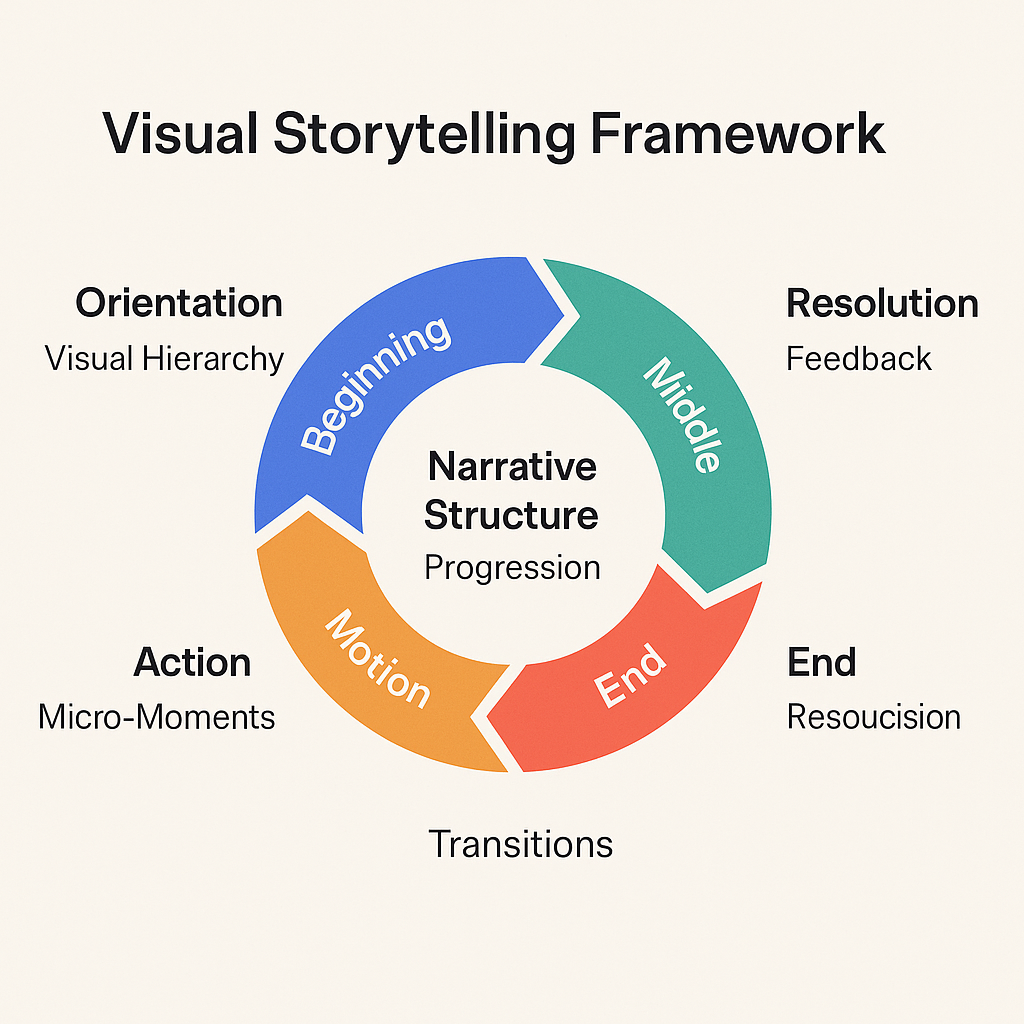
Every story has a structure, whether written intentionally or not.
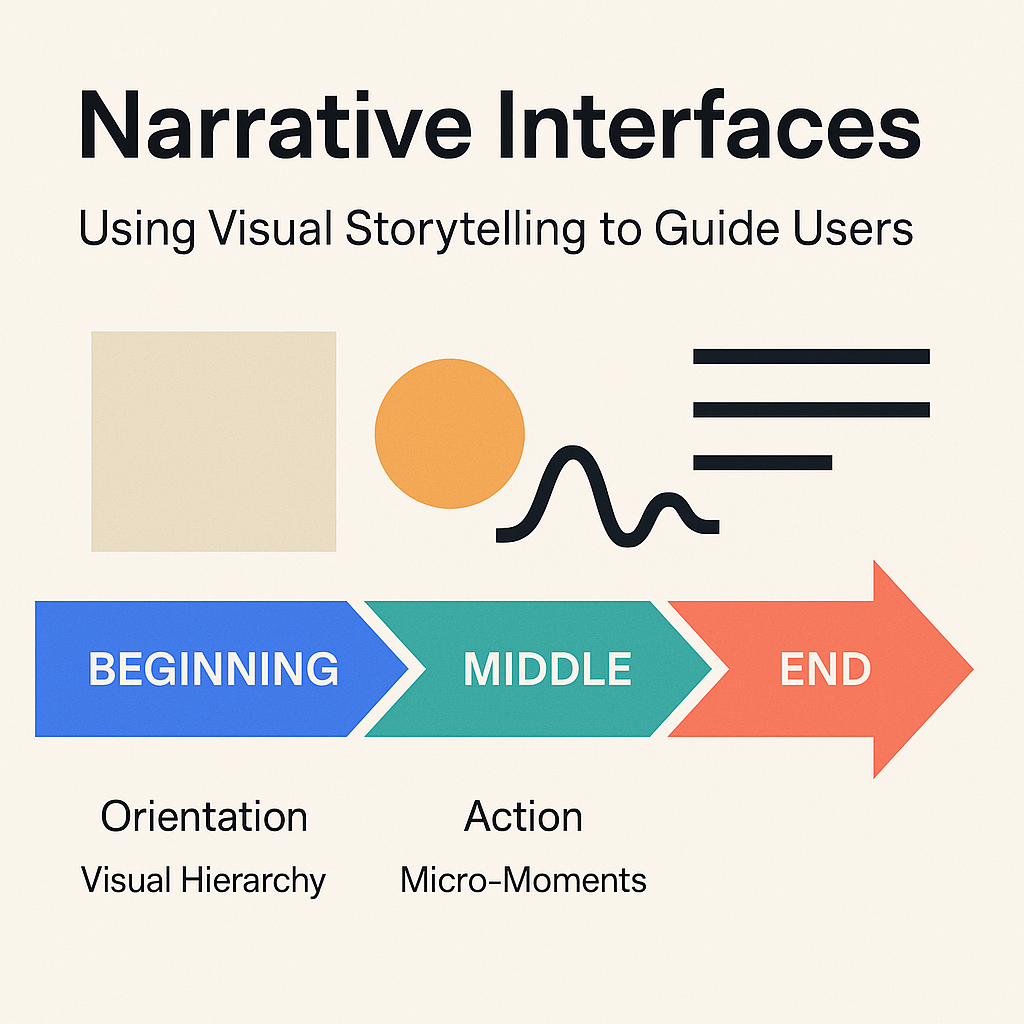
In interfaces, that structure usually looks like:
-
a beginning (orientation)
-
a middle (action and decision)
-
an end (resolution or continuation)
When this structure is unclear, users experience anxiety. They don’t know where they are in the journey, how much effort remains, or whether they’re moving forward or sideways.
Narrative design gives users a sense of progression — even in small tasks. This sense of progression is one of the strongest tools for reducing uncertainty and increasing trust.
It also directly supports reducing cognitive load through layout clarity
Visual hierarchy is narrative pacing
In storytelling, pacing determines how fast information is revealed.
In interfaces, pacing is created through visual hierarchy.
What appears first?
What is loud, and what is quiet?
What waits its turn?
Good hierarchy doesn’t overwhelm. It sequences attention. It allows the interface to “speak” one idea at a time.
When everything demands attention, the story collapses. When hierarchy is intentional, the interface feels calm — even when it’s complex.
Narrative interfaces rely on hierarchy to decide which parts of the story are foreground and which remain contextual. This is where layout becomes storytelling, not decoration.
Motion is the connective tissue of the story
Stories don’t jump between scenes without transition. Interfaces shouldn’t either.
Motion connects moments. It explains relationships. It tells users why something changed, not just that it changed.
When motion follows consistent rules, it becomes a language — a grammar users learn subconsciously. This idea is explored deeply in motion as grammar, but its narrative role deserves special attention.
Motion:
-
introduces new chapters (screen transitions)
-
emphasizes turning points (state changes)
-
provides closure (completion feedback)
Without motion, interfaces feel abrupt. With too much motion, they feel theatrical. Narrative motion sits in between — present, but not demanding applause.
Micro-moments are story beats
Stories are remembered through moments.
In interfaces, those moments often appear as subtle feedback, confirmations, or transitions. These are the beats that tell users, “Something happened,” “You’re on the right path,” or “This part is complete.”
When these beats are missing, users feel disoriented. When they are exaggerated, users feel manipulated.
The art is in restraint.
Motion that breathes — pauses, accelerates, softens — allows the interface to feel human. This quiet expressiveness is what gives power to interfaces that breathe.
Narrative reduces effort by making intent visible
One of the most underrated benefits of storytelling in UI is effort reduction.
When users understand why something is happening, they spend less energy figuring out what is happening.
Narrative interfaces make intent visible:
-
Why am I being asked for this information now?
-
Why did the interface respond this way?
-
What is the system preparing me for next?
This clarity dramatically reduces cognitive strain. It prevents users from constantly recalculating their mental model of the product.
In this sense, narrative is not emotional fluff — it’s cognitive efficiency.
Onboarding is the most obvious narrative — but not the only one
Most designers associate narrative with onboarding. And yes, onboarding is a story: introduction, promise, guidance, first success.
But narrative doesn’t end after onboarding. It continues in:
-
empty states
-
errors
-
loading moments
-
repeated daily tasks
A well-designed empty state isn’t just “nothing here yet.” It’s a narrative pause. A moment that says, “This is where the story will continue.”
Error states are moments of tension. How the interface responds determines whether users feel blamed or supported.
These moments often reveal whether narrative thinking was present — or absent — in the design process.
Stillness is part of the story
Not every moment needs motion. Not every screen needs emphasis.
In storytelling, silence creates meaning. In interfaces, stillness does the same.
Narrative design respects negative space, pauses, and moments where nothing changes. These moments allow users to process, decide, and feel in control.
Stillness also amplifies motion when it does occur. A single transition becomes meaningful when it isn’t competing with ten others.
This balance is what makes interfaces feel composed rather than restless.
Narrative consistency builds emotional memory
Users don’t consciously remember every interaction — but they remember how consistent a product felt.
Narrative consistency means:
-
similar actions produce similar outcomes
-
similar flows feel structurally familiar
-
emotional tone doesn’t fluctuate unpredictably
This consistency builds emotional memory. Users begin to trust the product not because it never surprises them, but because it surprises them within a known structure.
This is where narrative, motion, and layout converge into a single experience.
AI enters the story — not as a replacement, but as a collaborator
As AI tools become part of the design workflow, narrative thinking becomes even more important.
AI can generate screens, flows, and variations quickly. But speed without narrative coherence leads to fragmentation. Many disconnected ideas, no story.
When AI becomes a design partner [LINK → When AI Becomes a Design Partner: Rethinking the UX Workflow], the designer’s role shifts. Less time is spent generating options. More responsibility lies in shaping meaning.
Narrative becomes the designer’s compass:
-
deciding which paths matter
-
which moments deserve emphasis
-
which variations support the same story
AI can assist with execution. Narrative judgment remains human.
Narrative is what turns usability into experience
Usability ensures that something works.
Narrative ensures that it makes sense.
An interface can be usable and still feel cold, fragmented, or exhausting. Narrative design adds coherence. It turns actions into journeys and screens into chapters.
This doesn’t mean every product needs drama or personality. Even the most utilitarian tools benefit from narrative clarity. Especially them.
Because when users don’t have to think about structure, they can focus on intention.
Designing narrative interfaces is designing responsibility
Stories influence behavior. Interfaces do too.
When we design narrative flows, we shape how people move, decide, and feel. That comes with responsibility.
Narrative can manipulate, rush, or pressure — or it can support, clarify, and empower. The difference lies in intention.
Good narrative design respects autonomy. It guides without coercion. It makes options visible without hiding consequences.
This ethical layer is subtle, but essential.
Final thought: users don’t want stories — they want meaning
Users aren’t looking for entertainment.
They’re looking for understanding.
Narrative interfaces don’t tell stories to users. They allow users to understand the story they’re already part of.
When motion speaks clearly, when layout breathes, when transitions feel intentional, and when tools — even AI — serve a coherent vision, interfaces stop feeling like systems.
They start feeling like conversations.
And conversations, when designed well, are remembered.